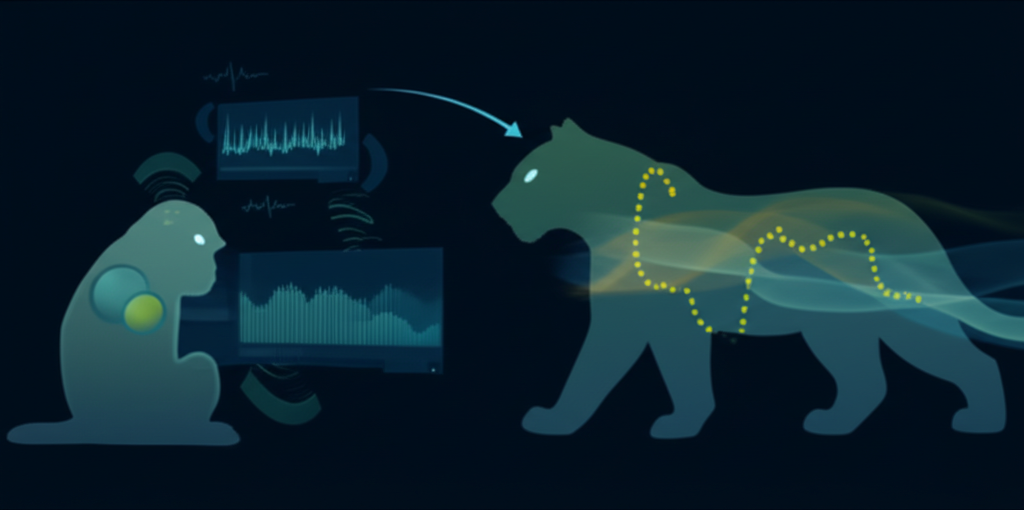
Research & Animal Welfare
Biometric feedback enrichment for animal welfare and research with adaptive, ethical stimuli.
Beyond Human Applications
Our patent application is drafted to include non-human subjects. The same technology that adapts content to human physiology can improve the lives of animals in zoos, research facilities, shelters, and homes.
Animal welfare is increasingly important to institutions and consumers alike. Biometric-responsive enrichment represents a new standard of care.
Applications
Zoo & Aquarium Enrichment
Generated content for animal enclosures that responds to behavior and stress markers. Reduce stereotypic behaviors, increase engagement.
Research Animal Welfare
Enrichment that adapts to individual animal responses. Better welfare, better science, better ethics.
Pet Anxiety
Calming content for thunderstorm anxiety, separation anxiety, and veterinary visits. Content that responds to actual stress levels.
Shelter Animals
Reduce stress, improve adoptability. Personalized enrichment for animals awaiting homes.
Agricultural Applications
Reduce livestock stress for improved welfare and yields. Ethical production with measurable outcomes.
Conservation
Support captive breeding programs with stress-optimized environments. Improve reproductive success for endangered species.
Target Partners
Zoos & Aquariums
- AZA member institutions
- WAZA members
- Major zoos worldwide
- Aquarium networks
Veterinary
- VCA Animal Hospitals
- Banfield Pet Hospital
- BluePearl
- Mars Petcare
Research
- University research facilities
- Pharmaceutical companies
- AAALAC members
- NIH/IACUC
A Niche With Impact
While smaller than other markets, animal welfare represents a meaningful application of our technology with strong ethical appeal and growing institutional demand.
Success here demonstrates the breadth of our patent application's applicability and opens doors to partnerships with mission-driven organizations.
Technical Deep Dive
For non-human subjects, we rely on contactless and wearable sensing: accelerometry for locomotor patterns and stereotypy, infrared thermography for stress, pupil dilation where feasible, vocalization analysis, and hormonal proxies (salivary cortisol schedules) where ethical. These signals feed a deviation estimator against an intended welfare state (reduced stereotypy, lower stress markers), conditioning a generative enrichment engine to synthesize new stimuli (visual/auditory/olfactory/haptic) rather than replaying preauthored loops.
The negative limitation in the application ("not pre-chosen, not pre-made, and not assembled from preexisting media assets") is critical for animal habituation prevention, ensuring novelty and engagement over time. Latency targets remain low (<100 ms) to maintain clear causal coupling between animal behavior and stimulus changes.
Multi-animal weighting supports group enclosures by aggregating individual stress/engagement embeddings with tunable weights. User records track stimulus-response trajectories to refine welfare interventions while satisfying IACUC/AAALAC documentation and ethical oversight requirements.
Interested in Research & Animal Welfare?
Let's discuss how Nourova's patent-pending technology can transform your research & animal welfare applications.
Discuss Licensing