Gaming
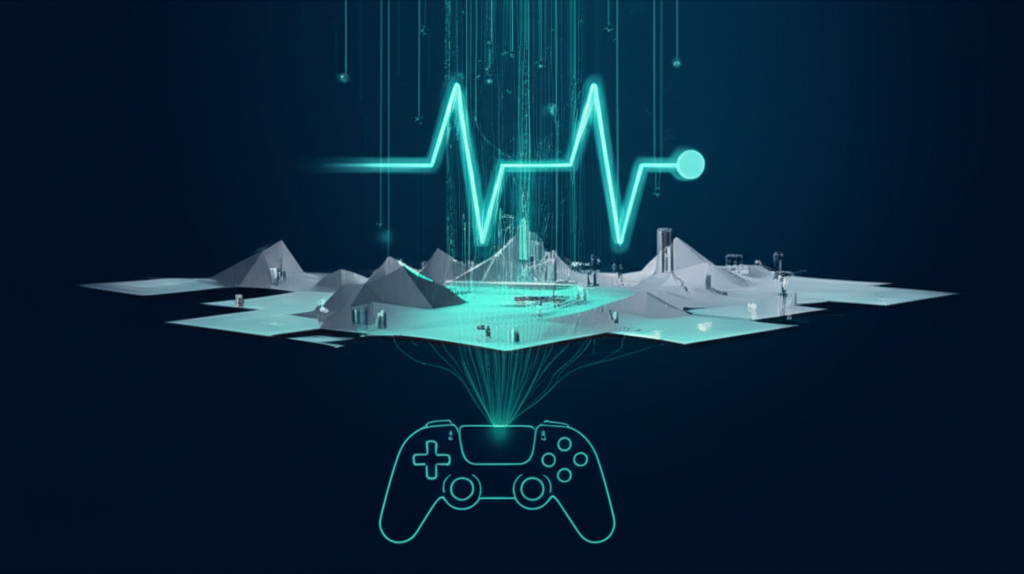
Biometric feedback gaming with adaptive horror, flow-state difficulty, and responsive VR experiences.
Applications
Adaptive Horror
Games that read your heart rate and skin conductance to dial terror up or down in real-time. Never too scary to quit, never boring enough to lose immersion.
Key biometrics: Heart rate, skin conductance, facial expression, eye tracking
Flow-State Difficulty
Dynamic difficulty that keeps players in the optimal challenge zone based on stress and focus indicators. No more frustration spikes or boredom valleys.
Key biometrics: HRV, EEG focus metrics, pupil dilation
Personalized Narrative
Story branches generated based on emotional investment—not pre-authored paths, but genuinely new narrative moments created for your experience.
Key biometrics: Engagement metrics, emotional response, attention patterns
VR/AR Immersion
Virtual reality experiences that respond to your sense of presence and comfort, adjusting environments to maximize engagement while preventing motion sickness.
Key biometrics: Vestibular response, nausea indicators, presence metrics
Esports Training
Generate scenarios that target specific biometric responses to build mental resilience, reaction time, and composure under pressure.
Key biometrics: Stress response, focus metrics, performance correlation
Multi-Player Adaptation
Weight multiple players' biometric inputs to create shared experiences that respond to the group's collective state.
Key biometrics: Group dynamics, synchronized responses, social engagement
Target Partners
Platform Holders
- Sony PlayStation
- Microsoft Xbox
- Nintendo
- Valve Steam
Engine Providers
- Epic Games (Unreal)
- Unity Technologies
- Amazon (Lumberyard)
- Godot Foundation
VR Hardware
- Apple (Vision Pro)
- Meta (Quest)
- Sony (PlayStation VR)
- HTC (Vive)
AAA Studios
- EA / Electronic Arts
- Activision Blizzard
- Ubisoft
- Take-Two Interactive
Licensing Models
Platform License
System-wide integration for platform holders. All games on the platform can utilize the technology.
- Platform-wide deployment
- Developer SDK included
- Technical support
Engine Integration
Native SDK integration with major game engines. Ongoing royalties from commercial releases.
- Reaches all developers
- Revenue share model
- Automatic updates
Per-Title License
Individual game licensing for AAA releases. Perfect for studios wanting exclusive features.
- Single title focus
- Custom implementation
- Marketing support
Why Gaming is Our Primary Target
Gaming companies are actively seeking differentiation in an increasingly competitive market. Biometric-adaptive content is the next frontier after ray tracing and AI upscaling.
The infrastructure already exists: VR headsets with eye tracking, controllers with heart rate sensors, and an audience eager for more immersive experiences.
This is where the technology demand is burning brightest—and where we can demonstrate clear, measurable value immediately.
Technical Deep Dive
Our patent-pending loop runs as a closed-form control system: multimodal biometric ingest (PPG/ECG for HRV, EDA, pupillometry, facial EMG/vision, EEG/SSVEP) feeds a deviation calculator against an intended physiological response, which then conditions a generative policy to synthesize new audiovisual/game-state segments rather than selecting from pre-authored assets. This constraint—“not pre-chosen, not pre-made, not assembled from preexisting media assets”—is what differentiates the pipeline from branching/DAG-based prior art (e.g., Everett/Chappell style recombination).
In practice, we fuse biometric features using a transformer-based state encoder and drive world/physics parameters (lighting, camera trajectory, NPC affect, audio timbre) via low-latency control heads. Target end-to-end latency from biometric sample to rendered frame is <50–80 ms to preserve presence and avoid motion-sickness in VR. Reinforcement learning or bandit-style policies can optimize for session-level reward (engagement, retention, arousal control) while respecting comfort constraints (e.g., cybersickness thresholds).
Multi-user weighting is supported for co-op and esports spectatorship: per-user embeddings are weighted and aggregated to drive shared scene synthesis, enabling group-responsive lighting cues, pacing adjustments, or dynamic camera work. The system can also attach auxiliary actuators (haptics, spatial audio arrays) with the same control signal, ensuring cross-modal coherence. All outputs are logged to a user record for continual fine-tuning of personalization models while maintaining privacy budgets.
Interested in Gaming?
Let's discuss how Nourova's patent-pending technology can transform your gaming applications.
Discuss Licensing