Entertainment & Streaming
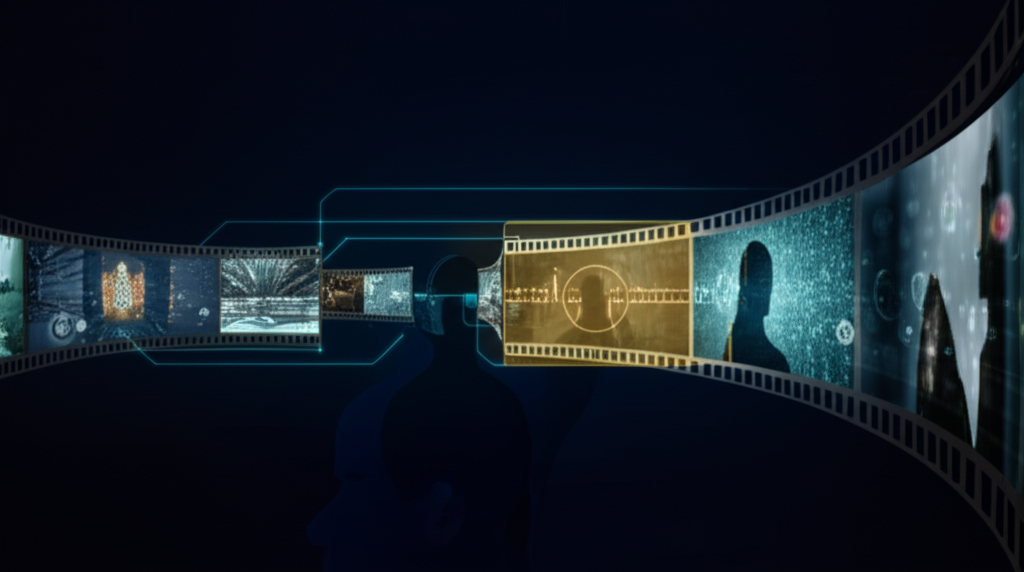
Real-time biometric feedback for adaptive film, music, and live experiences that respond to engagement.
The Future of Personalized Content
Streaming services recommend what to watch next. But the content itself remains static—the same movie for every viewer, regardless of whether they're engaged or bored.
Our technology enables content that generates in response to viewer engagement, creating truly personalized entertainment experiences.
Applications
Adaptive Films
Horror that reads your fear level. Comedy that tracks your amusement. Drama that responds to your emotional engagement. Pacing that adapts to attention.
Infinite Personalized Content
"Generate me a thriller in the style of Christopher Nolan that keeps me on the edge of my seat." AI generates the content; your body tells it when it's working.
Interactive Storytelling
Netflix's Bandersnatch, but your BODY chooses the path. No conscious decisions— the story follows your emotional responses.
Theme Park Experiences
Rides and attractions that adapt to rider biometrics. More thrills for those who want them, gentler experiences for those who need them.
Live Events
Concerts and performances that adapt to aggregate audience biometrics. The show responds to the crowd's energy in real-time.
Music Generation
Adaptive soundtracks that respond to your mood and activity. Music that helps you focus when you need focus, energizes when you need energy.
Target Partners
Streaming
- Netflix
- Disney+
- Amazon Prime
- Apple TV+
- HBO Max
Theme Parks
- Disney Imagineering
- Universal Creative
- Epic Universe
- Cedar Fair
Live Events
- Live Nation
- AEG
- MSG Entertainment
- Major venues
Music
- Spotify
- Apple Music
- Amazon Music
- AI music startups
Timeline Consideration
Entertainment represents the largest long-term opportunity as real-time generative AI video matures. Technologies like Sora, Runway, and Pika are just emerging.
However, music and audio applications are ready now. And theme parks and live events can begin implementing with current technology while video generation catches up.
Technical Deep Dive
The patent application is directed to a closed-loop generative pipeline that ingests multimodal biometrics (EDA, HRV, eye-tracking, facial expression, EEG) and computes a deviation between current affective state and an intended physiological response. That deviation conditions a generative model to synthesize new story segments, sonic motifs, or visual treatments—not to pick from pre-rendered clips—while maintaining seamless continuity (no “scene pops” or audio discontinuities).
On the rendering side, we modulate pacing, narrative tension, camera motion profiles, color grading, lighting, and soundtrack orchestration in real time. Low-latency control heads sit atop a transformer state encoder to guarantee sub-100 ms response from biometric change to perceptual change—critical for immersion and avoiding uncanny adaptation. For group experiences (theme parks/live events), per-viewer embeddings are weighted to drive aggregate cues (lights, audio spatialization) without washing out individual sensitivities.
All outputs are generated under the negative limitation in the application ("not pre-chosen, not pre-made, and not assembled from preexisting media assets"), distinguishing this approach from legacy branching/DAG systems. Auxiliary actuators (LED arrays, scent/haptic emitters) can be driven from the same control signal to ensure cross-modal coherence, and user records log biometric-to-content mappings for continuous fine-tuning while respecting privacy budgets.
Interested in Entertainment & Streaming?
Let's discuss how Nourova's patent-pending technology can transform your entertainment & streaming applications.
Discuss Licensing