Automotive
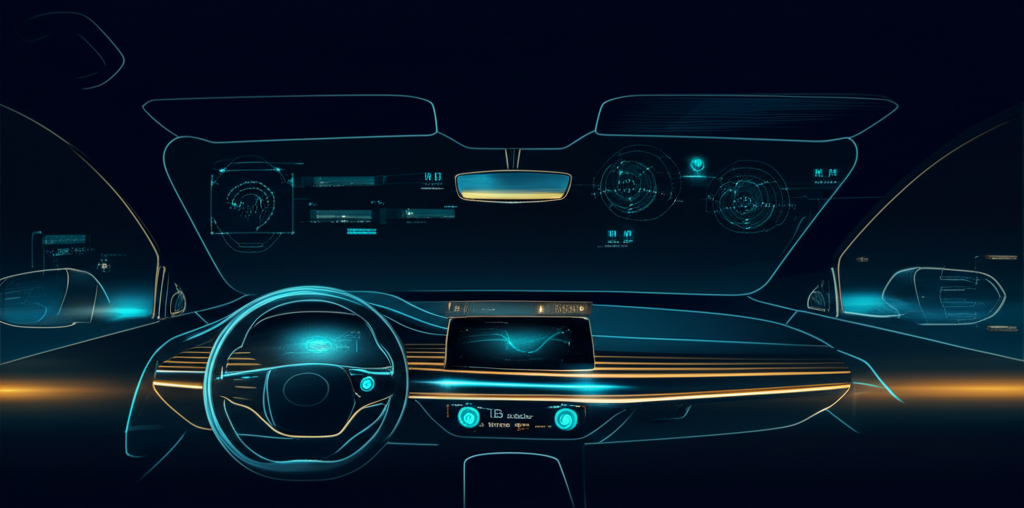
Biometric feedback for driver alertness and passenger comfort, with real-time adaptive cabin experiences.
The Connected Cabin
Vehicles are becoming living spaces. As autonomy increases, the cabin experience becomes the differentiator. And even for driven vehicles, safety and comfort can be enhanced through biometric responsiveness.
Our technology enables vehicle environments that respond to occupant state— from safety interventions to entertainment optimization.
Applications
Driver Alertness
Generate stimulating content when drowsiness is detected. Audio cues, visual alerts, climate adjustments—all driven by actual fatigue markers.
Passenger Comfort
Content adapted to motion sickness indicators. Entertainment that responds to stress levels. Climate that adjusts to physiological comfort.
Autonomous Interiors
When the car drives itself, the cabin becomes an experience space. Biometric-responsive content fills the journey with personalized media.
Fleet Safety
Commercial driver wellness monitoring and intervention. Reduce accidents through real-time fatigue management.
Target Partners
OEMs
- Tesla
- Mercedes-Benz
- BMW
- Ford
- GM
Tier 1 Suppliers
- Bosch
- Continental
- Denso
- Aptiv
AV Companies
- Waymo
- Cruise
- Aurora
- Zoox
Fleet Management
- Samsara
- Geotab
- Omnitracs
- KeepTruckin
Timeline Consideration
Automotive integration cycles are long—3-5+ years from concept to production. However, early engagement with OEMs and Tier 1 suppliers positions us for the autonomous vehicle transition.
Fleet safety applications offer a faster path to market with existing vehicles through aftermarket or software solutions.
Technical Deep Dive
Cabin-facing sensors (PPG/ECG in steering, EDA from conductive surfaces, eye-tracking/IR for drowsiness, head-pose, facial thermography) are fused to estimate driver and passenger state. A deviation calculator compares measured arousal/alertness to an intended target (e.g., safe vigilance band) and conditions a generative control model to synthesize interventions—audio motifs, lighting temperature/hue, HVAC adjustments, seat haptics—under the same “not pre-chosen, not pre-made, not assembled from preexisting assets” constraint.
Safety-critical paths demand deterministic latency budgets (<50 ms) and bounded actuation envelopes to avoid startle or motion-sickness. For AV cabins, the same loop modulates entertainment content, camera/view modes, and spatial audio to maintain comfort in dynamic motion profiles. Multi-occupant weighting enables equitable experiences (e.g., balancing a child’s motion sickness signal against an adult’s stress signal) with tunable weights.
All actions are logged to a user/vehicle record to support fleet-wide personalization while respecting privacy and regulatory constraints (GDPR/BIPA). The generative approach prevents repetitive patterns and allows adaptation to individual physiology over time without relying on canned alerts or static media playlists.
Interested in Automotive?
Let's discuss how Nourova's patent-pending technology can transform your automotive applications.
Discuss Licensing